Package Design
This section outlines the modular structure of DebrisPy and summarises how
the main components of the package interconnect.
ASD pipeline and data flow
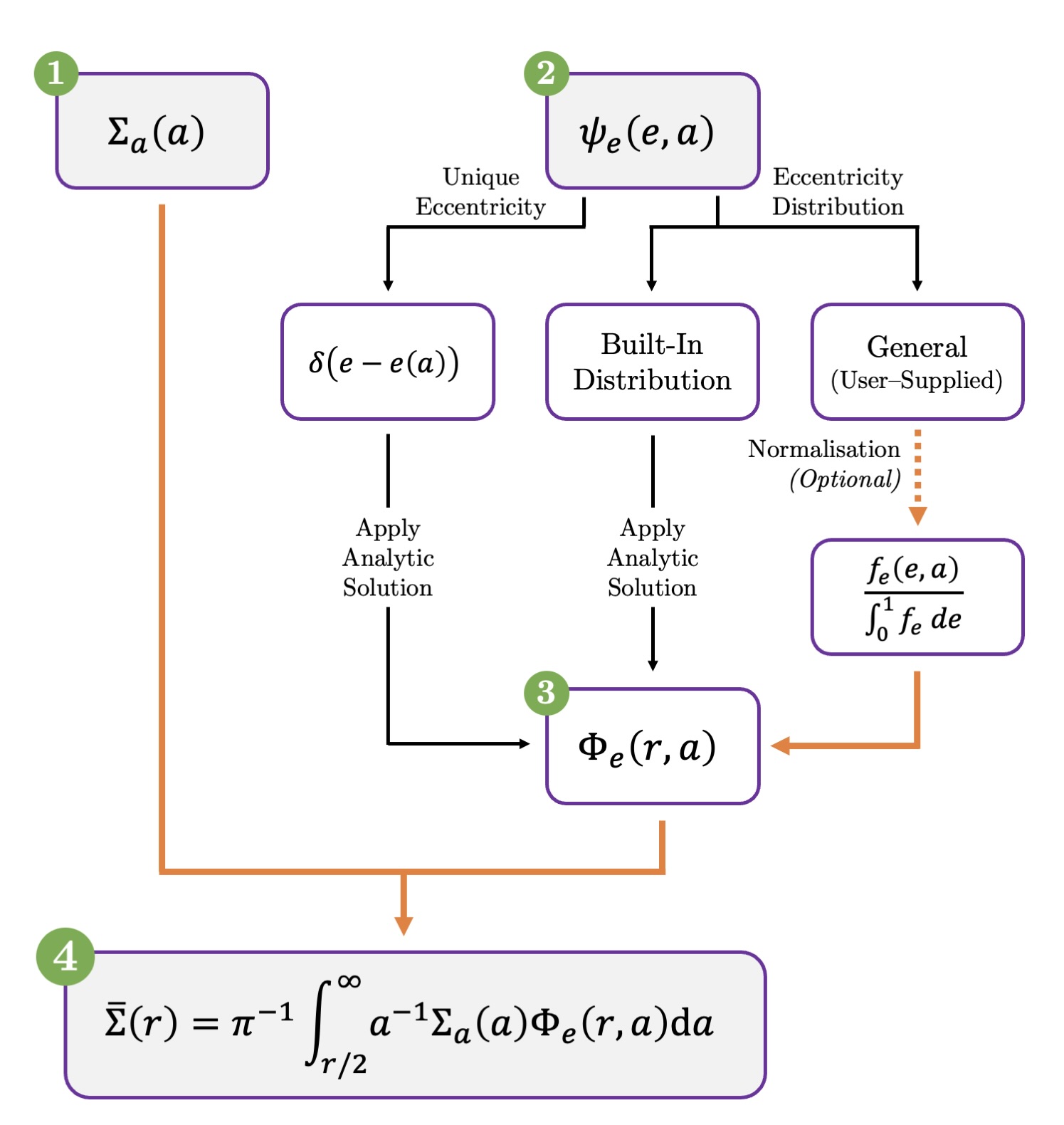
The diagram below summarises the data flow and functional organisation of
DebrisPy. Each numbered step corresponds to a core component in the ASD
calculation pipeline.
Mass distribution in semi-major axis — \(\Sigma_a(a)\)
The pipeline begins with the user-supplied mass distribution in semi-major axis. This may be chosen from one of the built-in profiles, such as a power law, Gaussian, or step function, or supplied as a custom vectorised function (see Using the SigmaA Class).
Eccentricity model — \(e(a)\) or \(\psi_e(e,a)\)
The user then specifies the eccentricity structure of the disc.
DebrisPysupports both deterministic eccentricity profiles and full eccentricity distributions:Unique eccentricity: a deterministic mapping \(e=e(a)\) (see Unique Eccentricity Profiles).
Built-in distributions: predefined eccentricity distributions, such as the Rayleigh distribution (see Built-In Eccentricity Distributions).
User-supplied distributions: arbitrary vectorised functions \(\psi_e(e,a)\), with optional numerical normalisation (see Custom Eccentricity Distribution).
User-supplied functions must be vectorised, since
DebrisPyevaluates profiles and distributions on NumPy arrays. Use NumPy-aware operations such asnp.where, boolean masks, and array arithmetic instead of scalar Pythonif/elsestatements.Kernel calculation — \(\Phi_e(r,a)\)
For each eccentricity model,
DebrisPyconstructs the eccentricity kernel, \(\Phi_e(r,a)\). Analytic kernel expressions are used where available; otherwise the kernel is evaluated numerically using one of the supported integration schemes. The kernel can be thought of as encoding how material with semi-major axis \(a\) contributes to the radial surface density at radius \(r\) (see Using the Kernel Class).ASD integration — \(\bar{\Sigma}(r)\)
Finally, the package computes the azimuthally averaged surface-density profile by evaluating
\[\bar{\Sigma}(r) = \pi^{-1} \int_{r/2}^{\infty} a^{-1} \Sigma_a(a) \Phi_e(r,a) \,\mathrm{d}a .\]The calculation is performed on a user-specified radial grid, with optional CPU parallelisation and adaptive radial refinement for sharply structured profiles (see The ASD Class).
Each stage is handled by a dedicated module with a consistent interface. This modular design allows individual components to be tested, validated, reused, or replaced independently, while keeping the full ASD pipeline compact and transparent.
Intermediate quantities, such as eccentricity kernels and interpolated profile values, are cached where possible to avoid unnecessary recomputation. These quantities remain accessible to the user, making it possible to inspect or reuse intermediate stages of the calculation.
Additional functionality
In addition to the main semi-analytic ASD pipeline, DebrisPy includes a
Monte Carlo sampler for generating particle realisations of the same underlying
orbital distributions (see Monte Carlo Sampling). These samples can be used to
construct one-dimensional radial histograms or two-dimensional maps in
Cartesian or polar coordinates, providing an independent check on the
semi-analytic calculation and a useful visualisation of the orbital structure.
DebrisPy also includes convolution utilities for comparing high-resolution
model profiles and maps with observationally resolved data. One-dimensional
profiles can be convolved with Gaussian kernels, while two-dimensional
Cartesian maps support Gaussian point-spread functions, including elliptical
and rotated beams.
Dependencies
DebrisPy requires Python 3.8 or higher. Core dependencies are installed
automatically when installing the package with:
pip install debrispy
The core dependencies are:
numpy: array manipulation and vectorised numerical operationsscipy: numerical integration, interpolation, and scientific utilitiesmatplotlib: plotting and visualisationfast_histogram: high-performance one- and two-dimensional histogrammingadaptive: adaptive sampling and grid refinement utilitiestqdm: progress bars for long-running calculationsjoblib: optional CPU parallelisation
Optional dependencies are available for development, testing, and documentation.
For development and testing:
pip install -e ".[dev]"
This installs additional packages such as pytest, ipykernel, and
notebook.
For building the documentation locally:
pip install -e ".[docs]"
This installs additional packages such as sphinx, sphinx-rtd-theme,
myst-parser, and nbsphinx.